
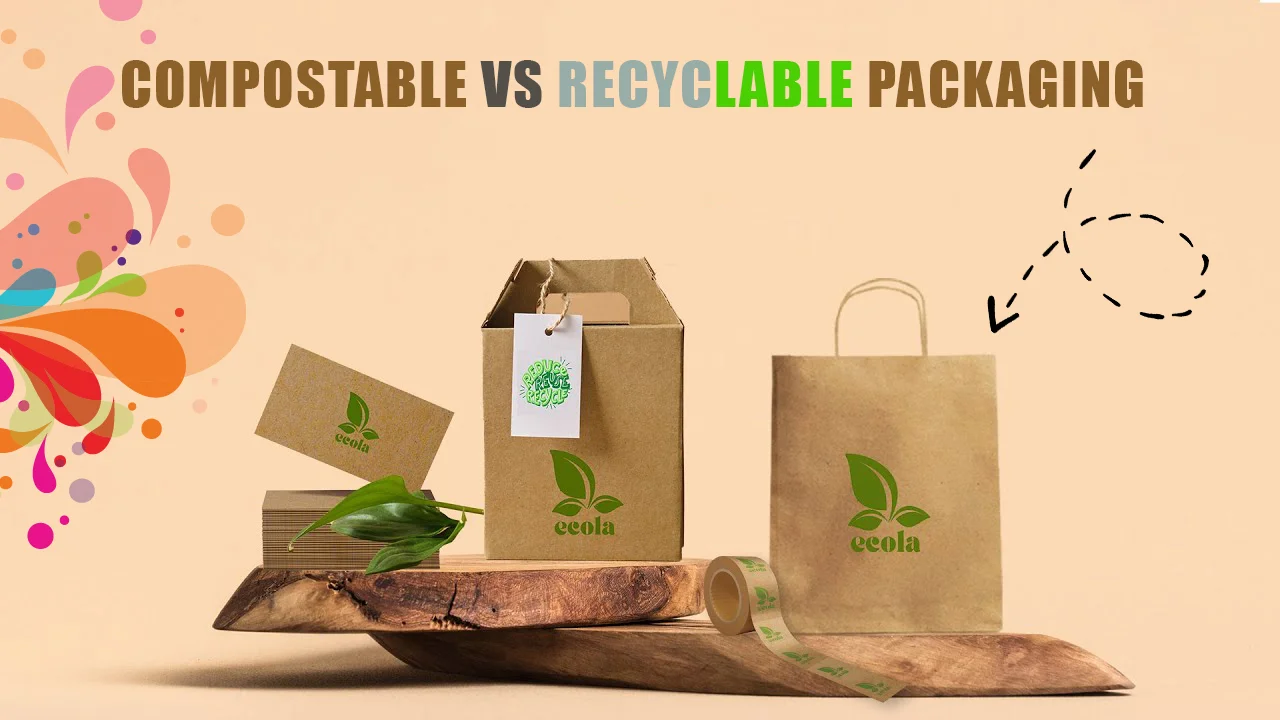
Do you want to promote your sustainable practices? You must be interested in sustainable packaging solutions to reduce environmental impact. If so, you are likely familiar with compostable vs recyclable packaging. Choosing between compostable and recyclable packaging can be a daunting task.
You should select the right material that best suits your product and brand needs. Don’t know their differences? Fret not! This blog is here to help. It covers everything about compostable vs recyclable packaging in detail. So, what are you waiting for? Let’s dive in and examine the difference between compostable and recyclable packaging.
Recyclable Vs Compostable Materials
Do you know the difference between recyclable and compostable? There is no need to worry at all. This guide is here to help you with everything related to recyclable vs compostable materials:
Recyclable materials
Paper, metal, glass, and some plastics are reprocessed into new products, extending their life. Recycling repurposes materials, often downcycling them.
Compostable Materials
Compostable materials such as food scraps, yard waste, and certified plant-based items break down into nutrient-rich soil, returning organic matter to the earth. Composting returns them to the soil as organic matter, reducing landfills and creating fertilizer for plants.
What is Recycling?
Recycling is the most popular process of collecting, processing, and turning the used and waste materials into new products. Why? It reduces the need for raw materials, saving energy and decreasing pollution.
Some of the resources, such as metals, can be melted down and made back into the same material repeatedly. While the other materials, such as plastic and paper can degrade each time to be recycled.
How Recycling Works?
The process of recycling works basically in three main steps. Take a look at these three major steps:
Collection
The first step is to place the recyclable materials in the curbside bins or drop them at recycling centers. Materials are separated by type in the recycling centers with the help of automated systems as well as manual sorting.
Cleaning & Processing
The next step is to remove the contaminants. The materials are cleaned and compressed into bales.
Manufacturing
The last step is the manufacturing. The processed materials are sold to manufacturers who create new products to create new boxes, plastic bottles, and many more.
What is Composting?
Composting is the natural process of recycling organic materials into a nutrient-rich soil amendment called compost. It improves the soil health, structure, and fertility for plants. It is an aerobic decomposition done by microorganisms such as bacteria, fungi, and worms that break down plant and animal matter.
The organic materials, such as food or yard waste, are inherently compostable. While the bioplastics must pass specific tests to be deemed compostable.
How Composting Works?
The process of composting works in several interconnected phases. Check out some of the main stages of this process:
Collection
The materials are collected separately from regular trash and recycling.
Facility Processing
Materials arrive at an industrial composting facility with controlled temperature, moisture, and oxygen levels. Microorganisms break down materials at 130-160°F for 90-180 days.
Curing
Compost is aged for several weeks to stabilize. Final compost is screened to remove any non-decomposed materials. And the finished compost is sold for agriculture, landscaping, or soil amendment.
Key Differences: Compostable vs Recyclable
Do you want to know the main considerations at a glance? Take a look at some of the most critical distinctions that actually matter for your business decisions:
| Factor | Recyclable Packaging | Compostable Packaging |
| End of Life | Reprocessed into new products | Breaks down into soil / organic matter |
| Processing Required | Industrial recycling facility | Industrial composting facility (usually) |
| Infrastructure Access (U.S.) | ~75% has curbside recycling | ~27% has composting access |
| Time to Break Down | Does not break down (reprocessed) | 90–180 days (industrial), 6–24 months (home) |
| Number of Use Cycles | 5–7 cycles before fiber degradation | One-time use (returns to earth) |
| Cost vs Conventional | 0–30% higher | 20–100% higher |
| Performance | Excellent (proven, durable materials) | Good to fair (newer technology) |
| Contamination Sensitivity | Sorting errors reduce recyclability | Food contamination is acceptable |
| Consumer Confusion | Low (established systems) | High (compostable vs biodegradable confusion) |
| Moisture Resistance | Excellent (especially plastics) | Limited (degrades with moisture) |
| Shelf Life | Indefinite if stored properly | 6–18 months (degrades over time) |
| Carbon Footprint | Lower (closed-loop material reuse) | Higher (single-use; composting releases CO₂) |
| Best For | Dry goods, durable items, and eCommerce | Food service, food-contaminated items |
| Worst For | Food-soiled packaging | Long shelf-life products |
| Greenwashing Risk | Low | High (misleading without compost access) |
The Difference Between Compostable and Biodegradable Packaging
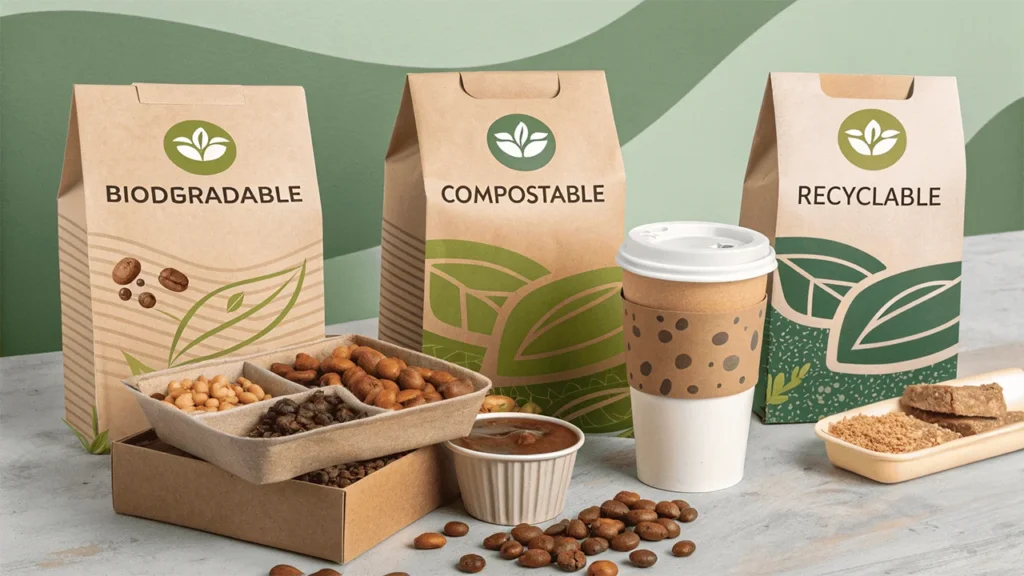
The terms “biodegradable” and “compostable” refer to similar processes with some key differences.
Compostable Packaging Meaning
Compostable packaging is a sustainable option made from natural and renewable materials. It is designed to break down completely into nutrient-rich soil in a composting environment, leaving no toxic residue. Have a look at some of the compostable packaging for businesses:
Compostable Food Packaging
Food chains are continuously looking for compostable food packaging to promote their sustainable practices. These packaging boxes make your brand unique and make food items highly presentable.
Compostable Paper Packaging
Compostable paper packaging is the perfect way to promote your brand’s green initiative. These packaging boxes keep the packed items intact and make your items unique at every stage.
Compostable Mailers
Compostable mailers are the best medium to ship the packed items safely. These mailers represent your brand and protect the packed items safely.
Recyclable Packaging Meaning
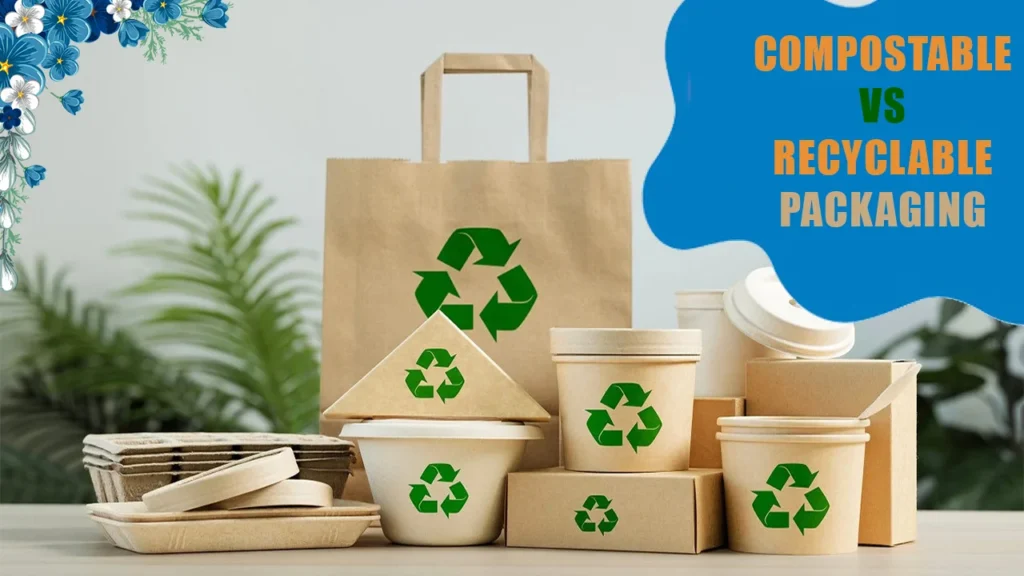
Recyclable packaging means the material can be collected, sorted, and reprocessed into new products. It diverts waste from landfills by entering a continuous material cycle. Have a look at some of the recyclable packaging for brands:
Recyclable Food Packaging
Recyclable food packaging is the new way to make your food chain attractive to foodie customers. These packaging boxes preserve the packed food and make it easy for the customers to carry it.
Recyclable Cardboard Packaging
Recyclable cardboard packaging offers a modern way to keep your items intact. These packaging boxes become the extinction of your brand and win the attention of the customers.
Recyclable Plastic Packaging
Recyclable plastic packaging offers a unique strategy to make your items unique. These packaging boxes strengthen your brand image and keep the items safe at every stage.
Compostable Vs Recyclable Packaging Cost
This table gives a clear cost comparison table for compostable vs recyclable packaging. Take a look at some of the most important considerations before any decision:
| Cost Factor | Recyclable Packaging | Compostable Packaging |
| Material Cost | Low to moderate | Moderate to high |
| Cost vs Conventional Packaging | 0–30% higher | 20–100% higher |
| Raw Material Availability | Widely available | Limited/seasonal |
| Manufacturing Complexity | Standard, mature processes | Specialized, newer processes |
| Economies of Scale | Strong (mass production) | Limited (smaller production runs) |
| Printing & Finishing Cost | Lower, compatible with most inks | Higher, limited ink & coating options |
| Durability & Damage Rate | High durability, low damage | Lower durability, higher damage risk |
| Shelf-Life Cost Impact | Minimal (long shelf life) | Higher (shorter usable life) |
| Storage & Handling Cost | Lower (stable materials) | Higher (sensitive to heat/moisture) |
| Waste & Failure Cost | Lower (recyclable even if unused) | Higher (expires or degrades over time) |
| Disposal Cost | Low (existing recycling streams) | Variable (depends on composting access) |
| Long-Term Brand Value | Moderate sustainability perception | High sustainability perception |
| Total Cost of Ownership | Lower for most industries | Higher, but marketing-driven value |
Compostable Vs Recyclable Packaging Pros And Cons
Don’t know which one to choose? There is no need to worry at all. Why? This guide covers this aspect as well in detail. Have a look:
Choose Recyclable Packaging When:
Packaging, toys, clothing, electronics, and cans should be designed to be recycled. Have a look at some of the most vital details you should consider when choosing recalled packaging:
- Customers have recycling access
- You need proven performance
- Budget is a constraint
- You’re shipping products
- A long shelf life is required
Choose Compostable Packaging When:
Ideally, all organic matter, such as food waste, grass clippings, fallen leaves, weeds, and manure, can be composted. Check some of the most important aspects to choose the compostable packaging:
- Food contamination is unavoidable
- Customers have composting access
- You are in food service
- Short shelf-life products
- Premium brand positioning
Designing Your Packaging for Recycling
We know most companies are seeking sustainable packaging to promote their brand’s green initiative. If that’s you, Tycoon Packaging has got you covered. We have all the skills to manufacture sustainable packaging solutions as per your needs through our customizable packaging solutions.
We also encourage you to avoid all plastics and help you use fully sustainable packaging. Worried about quality? We craft the packaging with complete precision by following your given specifications. Have concerns about rates?
We never compromise quality, but also offer wholesale rates. So, why wait then? Contact us, and we’ll guide you toward packaging that aligns with your business’s sustainability goals.
Conclusion
Compostable and recyclable packaging both support sustainability, but they serve different purposes. Recyclable packaging works best for clean, dry, and durable products. The compostable packaging is ideal for food-contaminated items. The most sustainable choice depends on real-world disposal conditions, infrastructure access, and product use. In many cases, a hybrid approach delivers the best environmental and business results.
Frequently Asked Questions
Q: Is compostable packaging better than recyclable packaging?
Not always. Compostable packaging is better for food-contaminated waste, while recyclable packaging is better for clean, dry items with strong recycling access.
Q: Can compostable packaging be recycled?
No. Compostable packaging should not go into recycling streams, as it can contaminate recyclable materials.
Q: Is recyclable packaging always recycled?
No. Recycling depends on local infrastructure and proper disposal. Many recyclable items still end up in landfills.
Q: Does compostable packaging break down in landfills?
Not effectively. Compostable materials need oxygen, heat, and microbes to decompose properly.
Q: Which is more cost-effective: compostable or recyclable packaging?
Recyclable packaging is usually cheaper, but compostable packaging can deliver higher environmental and branding value in food-focused applications.